> ## Documentation Index
> Fetch the complete documentation index at: https://ngquct-fix-editor-drop-rename-forgets-table-settings.mintlify.site/llms.txt
> Use this file to discover all available pages before exploring further.
# Cloud SQL Auth Proxy
> Connect to Google Cloud SQL by letting TablePro manage the Cloud SQL Auth Proxy
export const binary_0 = undefined
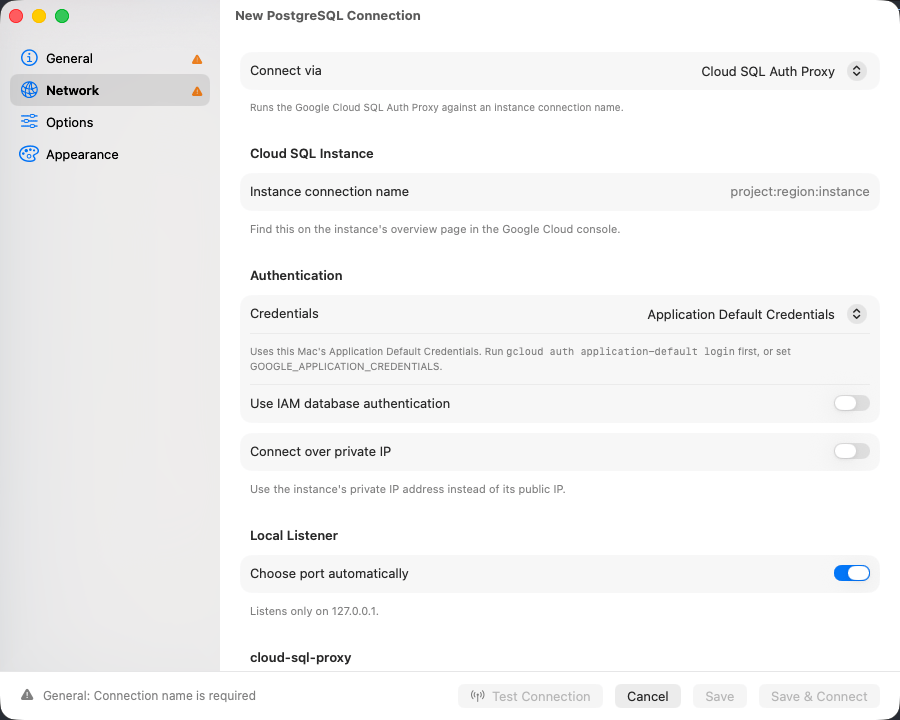
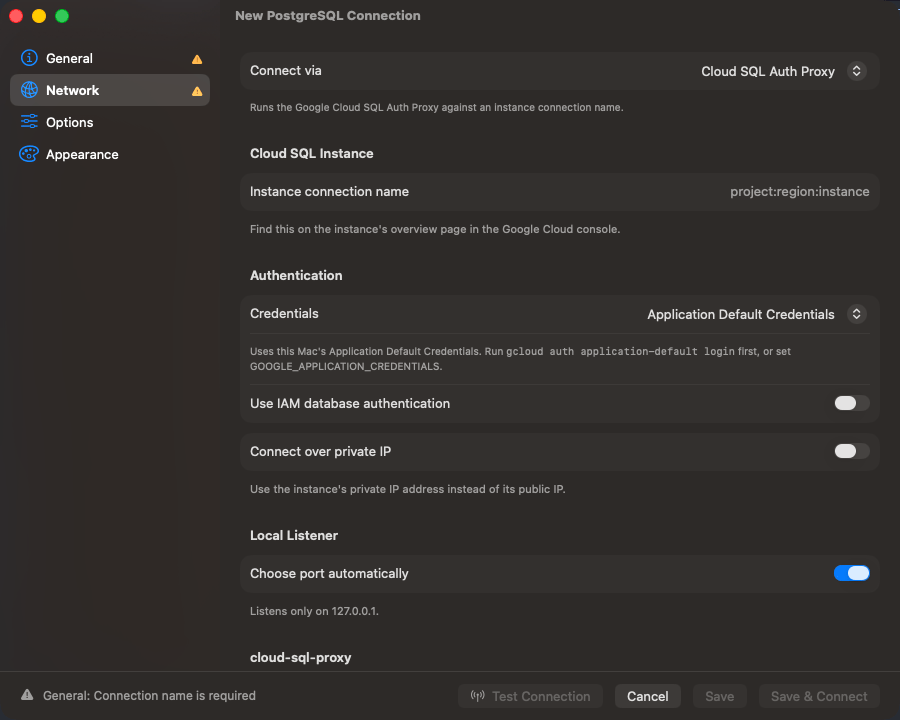
One field carries the whole setup: the instance connection name, `project:region:instance`, which is on the instance's overview page in the Google Cloud console. The proxy itself runs as a child process, started on connect and killed on disconnect.
 ## Before you start
The pane appears for Cloud SQL instances running MySQL, PostgreSQL, or SQL Server. The account you connect with needs the **Cloud SQL Client** role (`roles/cloudsql.client`) on the project, and for Application Default Credentials, one run of:
```bash theme={null}
gcloud auth application-default login
```
Install the binary, or click **Download cloud-sql-proxy…** in the pane, which fetches 2.23.0 and checks its SHA-256 against the value pinned for your CPU architecture.
```bash theme={null}
brew install cloud-sql-proxy
```
Auto-detection covers your `PATH`, `/opt/homebrew/bin`, `/usr/local/bin`, and `~/google-cloud-sdk/bin`. Anywhere else, use **Choose…**.
## Setting up
On the **Network** tab, set **Connect via** to **Cloud SQL Auth Proxy**. A connection uses one transport, so choosing this one switches off whichever was selected before.
Enter the **Instance connection name**, then choose **Application Default Credentials** or **Service Account Key**.
The proxy encrypts the leg to Cloud SQL and hands the driver plain loopback, so SSL/TLS stays off.
On **General**, click **Test Connection**. **Host** and **Port** there are never dialed: the instance connection name decides where the proxy lands. **Username** and **Database** work as usual.
## Options
| Option | What it does | Default |
| - | - | - |
| **Instance connection name** | `project:region:instance`. Three colon-separated parts, none empty, or the connect is refused outright. | - |
| **Credentials** | **Application Default Credentials**, or a **Service Account Key** pasted as JSON. | Application Default Credentials |
| **Use IAM database authentication** | Signs in as an IAM principal instead. Set **Username** to that principal, a user email or `name@project.iam` for a service account; the password goes unused. | Off |
| **Connect over private IP** | Reaches the instance on its private address instead of its public one. | Off |
| **Path** | The `cloud-sql-proxy` binary. Blank auto-detects. | Blank |
A pasted key is kept in the macOS Keychain and written to a temporary file readable only by you while the proxy runs, then deleted. It never reaches the command line.
`GOOGLE_APPLICATION_CREDENTIALS` works too, but the proxy inherits the app's environment, and a GUI app never sees variables exported by your shell profile.
| Option | What it does | Default |
| - | - | - |
| **Choose port automatically** | Takes a free loopback port, and tries up to five times if one is claimed first | On |
| **Local port** | Pins a fixed port instead. There is no retry, so a port already in use fails the connect | - |
TablePro polls that port and gives {binary_0} 30 seconds to answer on it. Past that the connect fails
and the error carries the last lines {binary_0} printed, which is where the real reason usually is.
## Troubleshooting
### cloud-sql-proxy was not found
Install it with `brew install cloud-sql-proxy`, download it from the pane, or set **Path**.
### The proxy did not become ready in time
Run it by hand to see what it says:
```bash theme={null}
cloud-sql-proxy --port 5433 --address 127.0.0.1 project:region:instance
```
### Permission or authentication errors
The proxy reports these on its own output, which the failed connect shows. Usually the account is missing the **Cloud SQL Client** role, Application Default Credentials were never set up, or IAM database authentication is on with no database user for the principal.
## Before you start
The pane appears for Cloud SQL instances running MySQL, PostgreSQL, or SQL Server. The account you connect with needs the **Cloud SQL Client** role (`roles/cloudsql.client`) on the project, and for Application Default Credentials, one run of:
```bash theme={null}
gcloud auth application-default login
```
Install the binary, or click **Download cloud-sql-proxy…** in the pane, which fetches 2.23.0 and checks its SHA-256 against the value pinned for your CPU architecture.
```bash theme={null}
brew install cloud-sql-proxy
```
Auto-detection covers your `PATH`, `/opt/homebrew/bin`, `/usr/local/bin`, and `~/google-cloud-sdk/bin`. Anywhere else, use **Choose…**.
## Setting up
On the **Network** tab, set **Connect via** to **Cloud SQL Auth Proxy**. A connection uses one transport, so choosing this one switches off whichever was selected before.
Enter the **Instance connection name**, then choose **Application Default Credentials** or **Service Account Key**.
The proxy encrypts the leg to Cloud SQL and hands the driver plain loopback, so SSL/TLS stays off.
On **General**, click **Test Connection**. **Host** and **Port** there are never dialed: the instance connection name decides where the proxy lands. **Username** and **Database** work as usual.
## Options
| Option | What it does | Default |
| - | - | - |
| **Instance connection name** | `project:region:instance`. Three colon-separated parts, none empty, or the connect is refused outright. | - |
| **Credentials** | **Application Default Credentials**, or a **Service Account Key** pasted as JSON. | Application Default Credentials |
| **Use IAM database authentication** | Signs in as an IAM principal instead. Set **Username** to that principal, a user email or `name@project.iam` for a service account; the password goes unused. | Off |
| **Connect over private IP** | Reaches the instance on its private address instead of its public one. | Off |
| **Path** | The `cloud-sql-proxy` binary. Blank auto-detects. | Blank |
A pasted key is kept in the macOS Keychain and written to a temporary file readable only by you while the proxy runs, then deleted. It never reaches the command line.
`GOOGLE_APPLICATION_CREDENTIALS` works too, but the proxy inherits the app's environment, and a GUI app never sees variables exported by your shell profile.
| Option | What it does | Default |
| - | - | - |
| **Choose port automatically** | Takes a free loopback port, and tries up to five times if one is claimed first | On |
| **Local port** | Pins a fixed port instead. There is no retry, so a port already in use fails the connect | - |
TablePro polls that port and gives {binary_0} 30 seconds to answer on it. Past that the connect fails
and the error carries the last lines {binary_0} printed, which is where the real reason usually is.
## Troubleshooting
### cloud-sql-proxy was not found
Install it with `brew install cloud-sql-proxy`, download it from the pane, or set **Path**.
### The proxy did not become ready in time
Run it by hand to see what it says:
```bash theme={null}
cloud-sql-proxy --port 5433 --address 127.0.0.1 project:region:instance
```
### Permission or authentication errors
The proxy reports these on its own output, which the failed connect shows. Usually the account is missing the **Cloud SQL Client** role, Application Default Credentials were never set up, or IAM database authentication is on with no database user for the principal.