> ## Documentation Index
> Fetch the complete documentation index at: https://ngquct-fix-editor-drop-rename-forgets-table-settings.mintlify.site/llms.txt
> Use this file to discover all available pages before exploring further.
# Procedures, Functions, and Triggers
> Browse stored procedures, functions, and triggers per schema and read their source
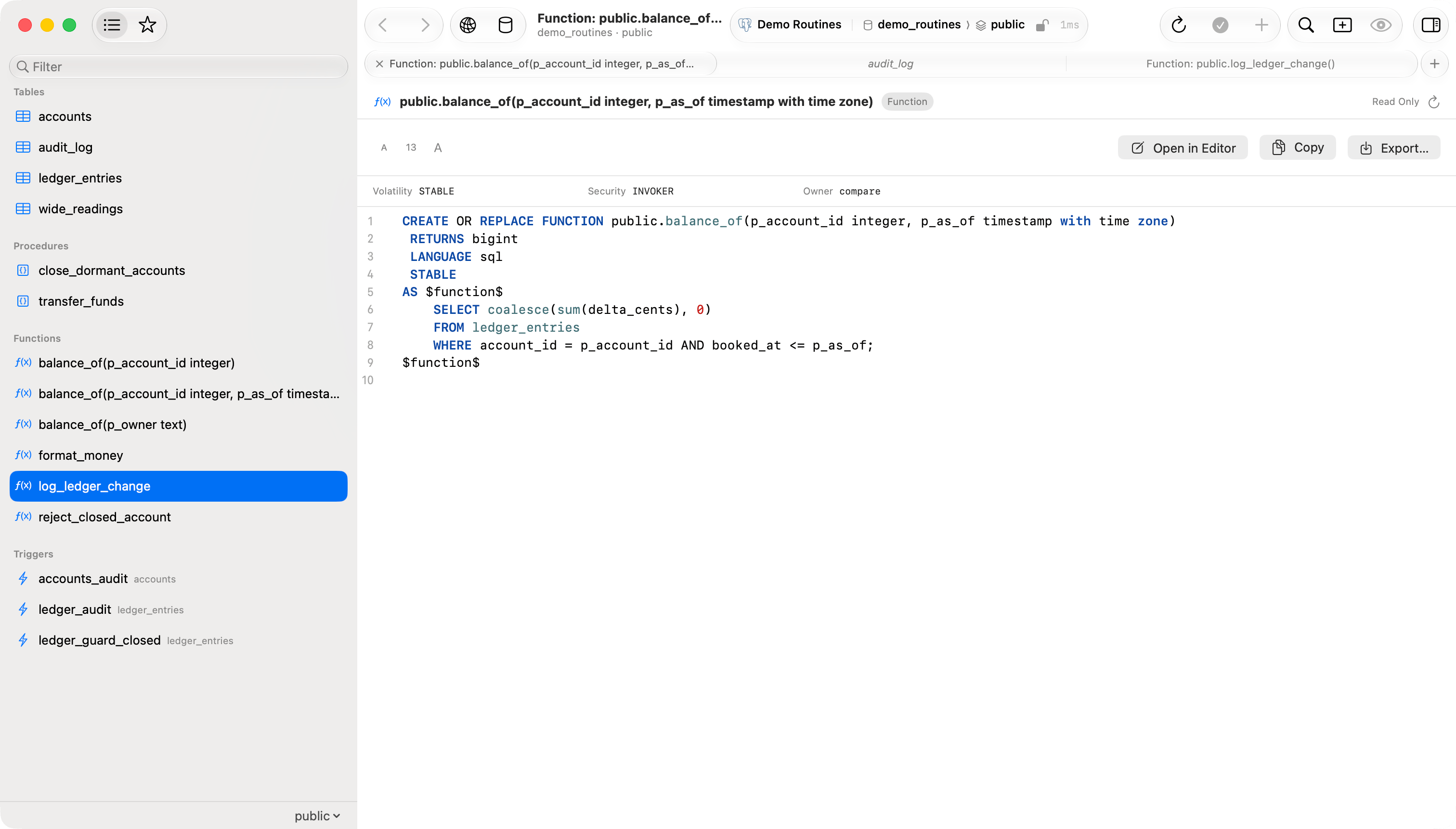
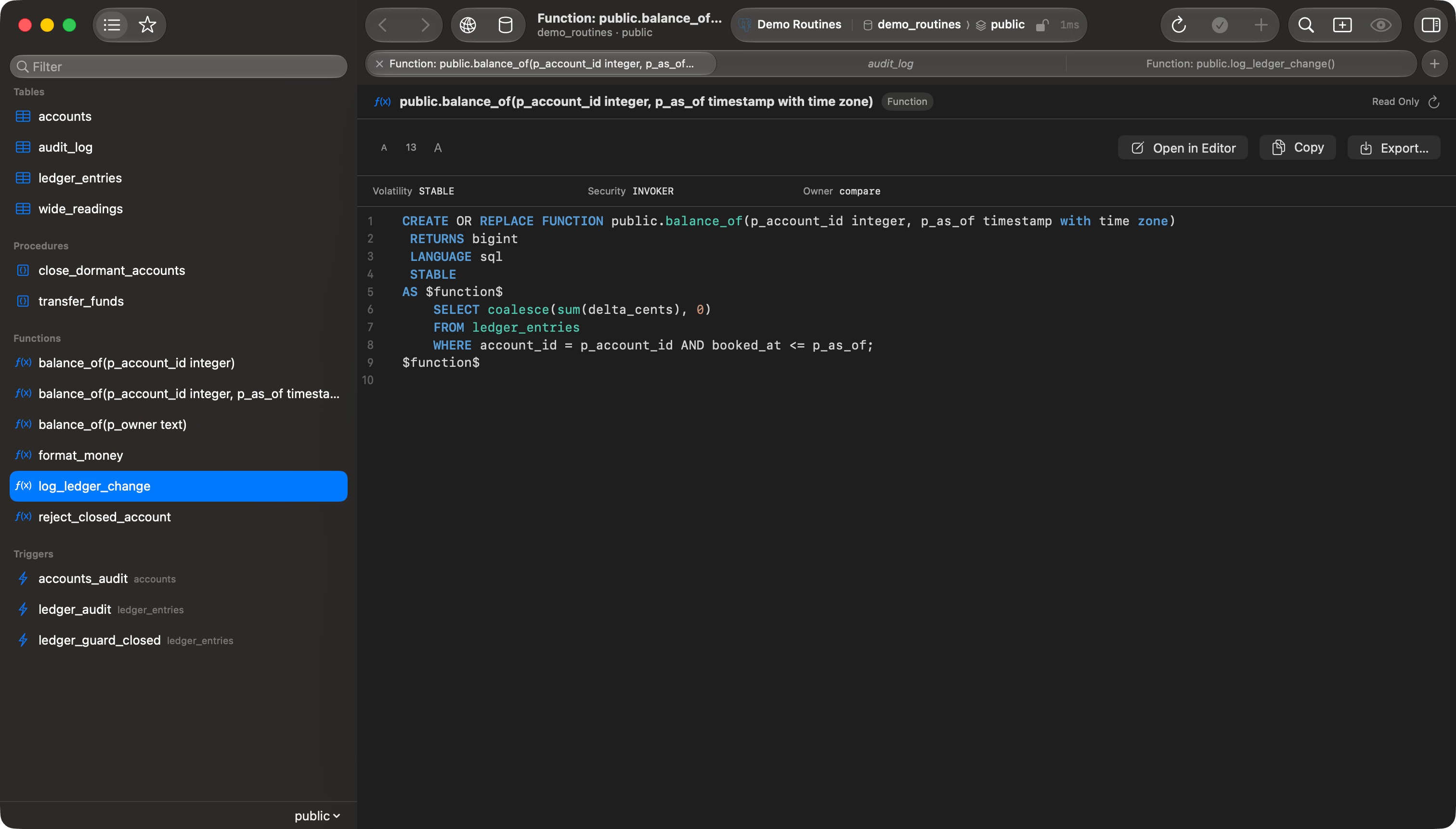
Expand a schema and **Procedures**, **Functions**, and **Triggers** sit beside **Tables**. Select one, press Return, and its source opens in a read-only tab. Named types have a section of their own; see [User-Defined Types](/features/user-defined-types).
 ## Engine support
| Engine | Procedures | Functions | Triggers |
| - | - | - | - |
| PostgreSQL | Yes | Yes | Yes |
| MySQL, MariaDB | Yes | Yes | Yes |
| MSSQL | Yes | Yes | Yes |
| Oracle | Yes | Yes | Yes |
| Dameng | Yes | Yes | Yes |
| Teradata | Yes | Yes | Yes |
| Snowflake | Yes | Yes | No |
| BigQuery | Yes | Yes | No |
| Cassandra, ScyllaDB | No | Yes, and aggregates | Yes |
| ClickHouse | No | Yes | No |
| DuckDB | No | Macros | No |
| SQLite, LibSQL, Cloudflare D1 | No | No | Yes |
| Redshift, CockroachDB, PGlite, SAP HANA | No | No | No |
| MongoDB, Redis, Elasticsearch, Typesense, DynamoDB, etcd, SurrealDB, Trino, Beancount, Spanner | No | No | No |
A section appears only where the engine has that kind of object. An engine that has them and currently holds none keeps the section and shows **No items** inside it, so a database with no tables still lists its procedures and functions. A section whose list is still on its way shows **Loading…**, and one the server refused shows the error in place of its rows.
## Finding a routine or trigger
A trigger row carries the table it fires for beside its name. The sidebar filter matches a trigger by its own name or by that table; type-select matches the name only. Triggers also appear on their table's **Structure** tab.
**File > Open Quickly…** (`Cmd+Shift+O`) indexes all three kinds alongside tables and views. Choosing one opens its source.
### Overloaded names
PostgreSQL lets several functions share a name with different argument lists. Where a name repeats inside a section, every row in that group gains its arguments: `transform(geometry, integer)` and `transform(geometry, text)`. A unique name stays bare. Each row opens its own definition.
## Reading the source
Return or a double-click opens the selected row. Right-click offers **Show DDL** for the same thing, plus **Copy Name** and **Copy with Signature**.
| Action | What it does |
| - | - |
| **Copy** | Puts the whole definition on the pasteboard |
| **Export…** | Saves it as a `.sql` file named after the object |
| **Open in Editor** | Opens the same text in a query tab, editable and runnable |
| **Reload** | Fetches the current definition from the server |
Beside the source sit the properties the engine reports: language, return type, volatility, security, and owner for a routine; timing, events, orientation, and enabled state for a trigger. The labels are the engine's own, so they differ between engines.
A viewer tab survives a relaunch and refetches when it reopens.
A DuckDB macro shows the expression DuckDB stored, not the `CREATE MACRO` text as typed.
## When the source is missing
| Message | What it means | What to do |
| - | - | - |
| Your account is not allowed to read the source of … | MySQL without `SHOW_ROUTINE`, MSSQL with `WITH ENCRYPTION` or without `VIEW DEFINITION`, Oracle without `SELECT_CATALOG_ROLE`, or a Teradata procedure created without SPL retention | Grant the privilege, or ask an account that holds it |
| … no longer exists | The object was dropped after the section was listed | Right-click the section and choose **Refresh** |
| This database cannot show the source of … | A Cassandra trigger is a Java class name with no body | Read the class name from the properties beside the empty source |
## Engine support
| Engine | Procedures | Functions | Triggers |
| - | - | - | - |
| PostgreSQL | Yes | Yes | Yes |
| MySQL, MariaDB | Yes | Yes | Yes |
| MSSQL | Yes | Yes | Yes |
| Oracle | Yes | Yes | Yes |
| Dameng | Yes | Yes | Yes |
| Teradata | Yes | Yes | Yes |
| Snowflake | Yes | Yes | No |
| BigQuery | Yes | Yes | No |
| Cassandra, ScyllaDB | No | Yes, and aggregates | Yes |
| ClickHouse | No | Yes | No |
| DuckDB | No | Macros | No |
| SQLite, LibSQL, Cloudflare D1 | No | No | Yes |
| Redshift, CockroachDB, PGlite, SAP HANA | No | No | No |
| MongoDB, Redis, Elasticsearch, Typesense, DynamoDB, etcd, SurrealDB, Trino, Beancount, Spanner | No | No | No |
A section appears only where the engine has that kind of object. An engine that has them and currently holds none keeps the section and shows **No items** inside it, so a database with no tables still lists its procedures and functions. A section whose list is still on its way shows **Loading…**, and one the server refused shows the error in place of its rows.
## Finding a routine or trigger
A trigger row carries the table it fires for beside its name. The sidebar filter matches a trigger by its own name or by that table; type-select matches the name only. Triggers also appear on their table's **Structure** tab.
**File > Open Quickly…** (`Cmd+Shift+O`) indexes all three kinds alongside tables and views. Choosing one opens its source.
### Overloaded names
PostgreSQL lets several functions share a name with different argument lists. Where a name repeats inside a section, every row in that group gains its arguments: `transform(geometry, integer)` and `transform(geometry, text)`. A unique name stays bare. Each row opens its own definition.
## Reading the source
Return or a double-click opens the selected row. Right-click offers **Show DDL** for the same thing, plus **Copy Name** and **Copy with Signature**.
| Action | What it does |
| - | - |
| **Copy** | Puts the whole definition on the pasteboard |
| **Export…** | Saves it as a `.sql` file named after the object |
| **Open in Editor** | Opens the same text in a query tab, editable and runnable |
| **Reload** | Fetches the current definition from the server |
Beside the source sit the properties the engine reports: language, return type, volatility, security, and owner for a routine; timing, events, orientation, and enabled state for a trigger. The labels are the engine's own, so they differ between engines.
A viewer tab survives a relaunch and refetches when it reopens.
A DuckDB macro shows the expression DuckDB stored, not the `CREATE MACRO` text as typed.
## When the source is missing
| Message | What it means | What to do |
| - | - | - |
| Your account is not allowed to read the source of … | MySQL without `SHOW_ROUTINE`, MSSQL with `WITH ENCRYPTION` or without `VIEW DEFINITION`, Oracle without `SELECT_CATALOG_ROLE`, or a Teradata procedure created without SPL retention | Grant the privilege, or ask an account that holds it |
| … no longer exists | The object was dropped after the section was listed | Right-click the section and choose **Refresh** |
| This database cannot show the source of … | A Cassandra trigger is a Java class name with no body | Read the class name from the properties beside the empty source |